The Committee of Interns and Residents (CIR) is the largest housestaff union in the United States. We are a local of Service Employees International Union (SEIU), representing over 40,000 resident physicians and fellows who are dedicated to improving residency training and education, advancing patient care, and expanding healthcare access for our communities.
Our Mission
We empower interns, residents and fellows to fight for excellence for our patients, our training, and our healthcare system through organizing, collective bargaining, and advocacy.
Medical training doesn’t have to be a demoralizing experience. CIR leaders are addressing the root causes of burnout. Our framework is one which allows us to come up with innovative solutions to systemic issues in medical training. Every day, we treat patients whose health has been compromised by a system that costs too much and leaves too many behind. We believe that a commitment to health justice for all requires us not only to be healers for our patients, but advocates.
Our History
CIR was founded by approximately two thousand interns and residents in New York City’s public hospitals in 1957. Our first collective bargaining agreement was signed in 1958. Staff pushed for higher salaries (which were raised from $852 to $1,212 per year), on-call rooms, hour limitations, better working conditions and quality of patient care – all of which we still continue to strive for today for our members. In the 1990s, CIR became a national union and in 1997 the delegates voted to affiliate with SEIU. Today, we are the largest housestaff union in the United States and we continue to grow. Read more.


What is Collective Bargaining?
CIR is not just an organization that we belong to. We are responsible to ourselves and each other, and it’s up to us to ensure that every single patient can get the care they need. Having a union helps us to do that.
We raise the standards for residency programs everywhere by transforming patient care and partnering with hospital administrators to make real change locally and nationally.
Every day, we treat patients whose health has been compromised by a system that costs too much and leaves too many behind. We believe that a commitment to health justice for all requires us not only to be healers for our patients, but advocates.
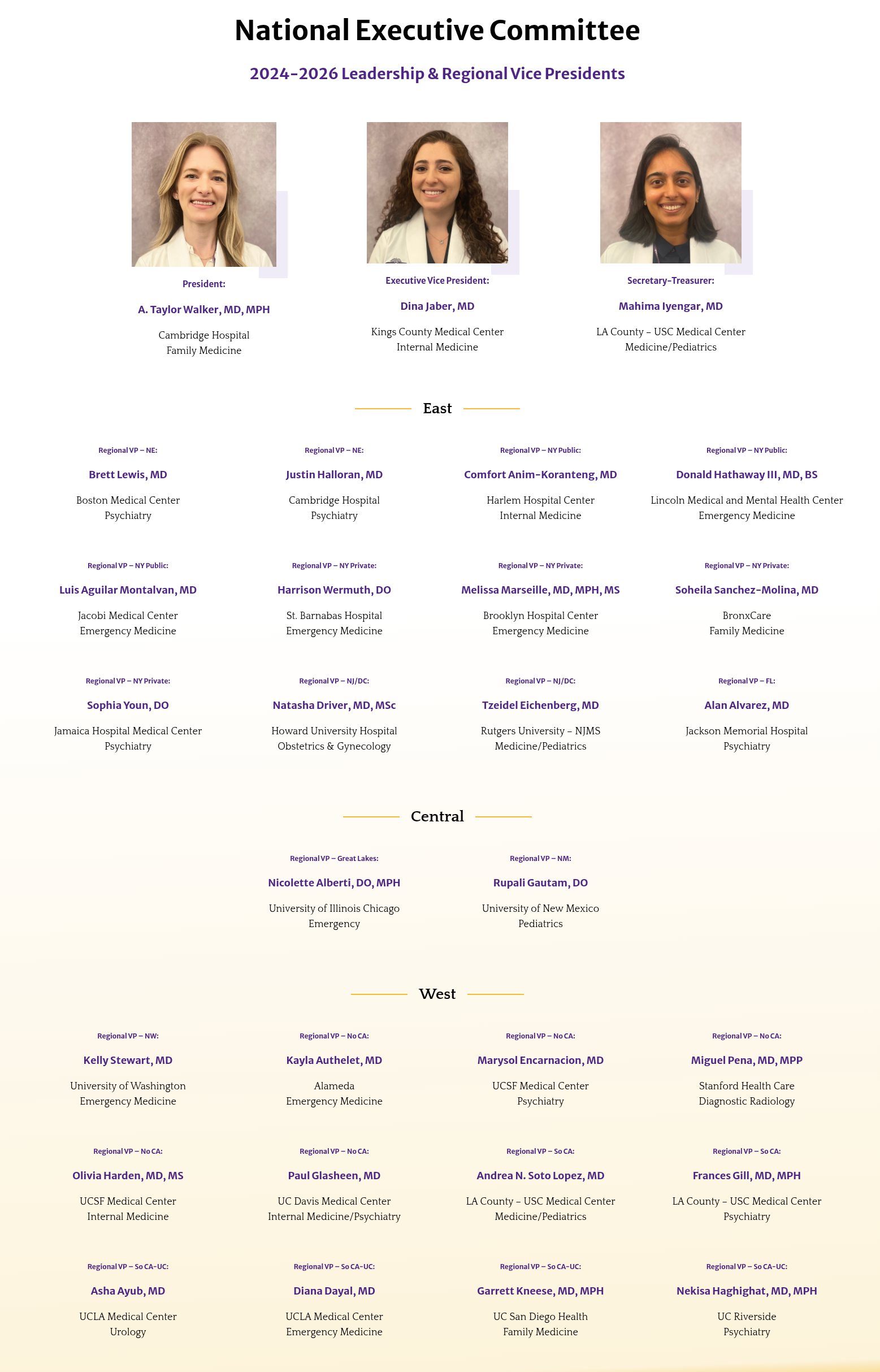
2026-28 Leadership

President:
Trina Van, MD
Children’s National Medical Center
Pediatrics

Executive Vice President:
Andrea Soto López, MD
Los Angeles General
Pediatrics

Secretary-Treasurer:
Melissa Marseille, MD, MPH
Brooklyn Hospital Center
Emergency Medicine
2026-28 Regional Vice Presidents
East

Jamie Ye
Psychiatry, Cambridge Health Alliance

Lucia Ryll
ENT, Boston Medical Center

Justin Halloran
Psychiatry, Cambridge Health Alliance
Safwan Elkhatib
Anesthesiology, Brigham and Women’s Hospital

Natalia Forbath, MD
Family Medicine Boston Medical Canter
Alexander Graff
Kings County Medical Center

Kyle MacNeil
Internal Medicine, Queens Hospital

Maxine Riter
Psychiatry, Westchester Medical Center
Joseph Botros
Montefiore Medical Center

Rohan Pinto
Internal Medicine, Maimonides Medical Center
Soheila Sanchez-Molina
Family Medicine, BronxCare Health System

Kevan Tafreshi
Internal Medicine, Wyckoff Heights Medical Center

Saeed Vazirian
Surgery, St. John’s Episcopal Hospital

Lane Kantor
Internal Medicine/Med Peds, University of Pennsylvania
Olivia Ladd-Luthringshauser
Children’s National Medical Center
Omar Taweh
Emergency Medicine, George Washington University

Akeim George
Pediatrics, Children’s National Medical Center
Maya McCoy
Med-Peds, Jackson Memorial Hospital
Central
Jasmine Chaparro
University of Illinois Chicago
Mo Kinsinger
Northwestern Medical

Joseph Ballard
Internal Medicine, University of Illinois Chicago

Nicole Centazzo
Pathology, University of New Mexico
West

Franz Belz
Psychiatry, Kaiser Permanente Northern California

Hope Schwartz
Emergency Medicine, Alameda

Miguel Pena
Diagnostic Radiology, Stanford Health Care
Zain Khalifeh
Medicine-Pediatrics, Los Angeles General
Shireen Saxena
Medicine-Pediatrics, Los Angeles General

Sat Kartar Khalsa
Emergency Medicine, UCSF Medical Center

Norman Archer,
Family & Community Medicine, UCSF Medical Center

Michelle Martinelli
Pediatrics, UCSF Medical Center

Miguel Gonzalez
Anesthesiology, UC Irvine
Rupali Gautam
UC San Diego

Suhail Sidhu
Internal Medicine, UC Irvine

Manraj Sekhon
UC Riverside

Charles Mitchell
Radiology, University of Washington

Kseniya Shin
Psychiatry, University of Washington